Tuesday, May 28, 2013

Revisiting Playa Grande, Costa Rica


Sunset at Playa Grande, Costa Rica - nesting site for the Pacific leatherback sea turtles!
Copyright (c) 2013 Wendee Nicole

I still have one more post yet to come from Costa Rica, but I first wanted to share the photos from our visit to Playa Grande, which is on the Pacific side of the small country in the Guanacaste region. We went here the last 2 days of our trip, and it was really poignant to go back to the place where, in 1999, I traveled to blog for The Discovery Channel for two weeks. The blog was called Love & Death on Turtle Beach and it was a wonderful moment in my life, right before a really bad part started!

Speaking of adventures, my next one begins this week! I will be headed to northern Cali again and staying with my friend Miranda Spencer and her hubster Bob Brulle who is doing a sabbatical at Stanford. We will be going to Sonoma where we will do a mud bath (naked!), hot springs, and wineries. We plan to visit Bachelor Ben Flajnik's winery, Envolve, which has its "tasting room" in Sonoma. I was interested that the wine is organic and raised using biodynamic techniques, though I so far have been unable to get a hold of them to possibly interview them for a story. I'm super excited to see my niece's mom and my friend Zofia, who I havent seen since I was en route to Dutch Harbor, Alaska! We spent the day together in San Fran! (and then I missed my flight, but it wasn't because I was late back to the airport, even!)

After Sonoma, Miranda, Bob & I plan to go camping in Big Sur. I've never been there, and it looks so gorgeous - very reminiscent of the Oregon coastline. I'm also applying to Stanford's EIPER PhD program for 2014... so will be meeting with some professors while there. Wish me luck! I am studying for the GRE lately... while writing and trying to get my house ready to sell next year. And without further adieu, here are the photos from one of the loveliest places in the world...


Seeing this hatchery again was so cool. I remember like it was yesterday sitting in the sand with Dana Drake, watching her sift through a nest, counting unhatched eggs and gathering turtles for release. You can read the blog post I wrote that day, The Hatchery.


A view of the beach through the palms.


Heidi strolling along the beach at sunset. We walked up and down the beach, taking photos and enjoying the sunset.


Another shot of the sunset. I am partial to sunset photos! And especially sunsets on the beach...


I was thinking this was Roca Bruja - Witch's Rock - a popular surf spot, but that is actually at Playa Naranjo. I don't know if this one has a name but it sure was a beautiful, peaceful evening. After the sunset, we ate at Hotel Las Tortugas, which was the place we ate at nightly during my two week stay there in 1999. They even had the same utterly delicious arroz con palmito dish (rice with hearts of palm) that I have been raving about for 14 years now! Then we walked out on the beach in the dark and looked at the stars, using the iPhone app on Gustavo's phone. It's funny because it ws a new moon yet the sky was not near as dark as I remember it back in Dec 1999. It was just utterly pitch dark then!


A shot of a wave as it crashes into the shore.


Me on the beach - a bit dark but there ya go! We stayed at the Hotel Tamarindo Diria, in neighboring Tamarindo, which was really nice but a massive 4-star resort/hotel with a golf course, etc.


On the long drive to Playa Grande from Heredia, where we stayed the nights before, we stopped at this roadside spot where Gustavo, our guide, knew that scarlet macaws were frequently spotted - Limonal. Sure enough, there was one!

Another shot. We only saw one macaw, but often there are several.
Another shot of the beautiful bird!

Last but not least, here are my latest articles:

*  I'm Carbon Neutral. Are You? Ensia Magazine, published online May 20, 2013. A closer look at the voluntary carbon offset market.

Adventurers Collect Data for Biologists: A Natural Symbiosis. BioScience. May 2013.

Thursday, May 02, 2013

A Writing Award!


Yours truly receiving the American Society of Journalists and Authors (ASJA) award for best article in the science/tech/biz category at the annual conference award ceremony. Thank you! Photo by Diana Pachecho, ASJA

All human nature vigorously resists grace because grace changes us and the change is painful. -Flannery O'Connor

I just returned from a quick trip to New York City where I attended the American Society of Journalists and Authors (ASJA) conference, and received my first national award for one of my articles. I feel very honored and blessed! It was for my article, Did Tap Water Kill Lou Gehrig? (the online title is slightly different). Here's a snapshop of the award itself:


I will post more photos from NYC soon, but I still need to finish posting my photos from the Costa Rica trip! But I wanted to post a quick update along with links to my latest article:

  Secret Ingredients (PDF): Who knows what's in your food? Environmental Health Perspectives April 2013 (online non-PDF version here).

This feature is all about food colorings, flavorings and other additives in our food, many apparently unregulated by the FDA... who knew? That's why it's called Secret Ingredients!

I have a feature coming up about environmental justice and the hog industry in North Carolina next month, which came out of my attending Professor Steve Wing's session at the National Association of Science Writers (NASW) conference in NC last October (which I blogged about here). And I finished a piece on carbon offsets for Ensia, that should be out fairly soon, and right now I'm working on a piece about EARTH University and its unique sustainable agriculture education for students from around the world.

Sunday, April 21, 2013

Jungle wildlife in Sarapiquí

After spending the day at Earth University on our second day, we stayed at the La Quinta Sarapiquí Inn (not related to the La Quinta chain of hotels in the US!). 


During breakfast the next morning, there were several colorful birds and a green basilisk lizard eating bugs on the roof across the way. It is very colorful! I also saw the related brown color Jesus Christ down by the pond that I walked to on the grounds.


He would stick his head in between the tiles, presumably looking for insects to eat!


A female green honeycreeper.

I believe that this is the male green honeycreeper along with an unidentified brown bird. The greenish color of the make and female is different which is weird... Actually that blue one is maybe a different species of bird...

In not quite sure what that blue bird is doing to the brown bird's behind! Ha ha! Just kidding - awkward photo angle, I think. If I'm identifying them right, the right is the female green honeyvcreeper

Two blue-gray tanagers.

These Passerini's tanagers were common.


Breakfast at La Quinta - a typical Costa Rican breakfast includes gallo pinto (black beans and rice), eggs, plantains, and fresh fruit.

A cool red flower at the hotel grounds.

The third morning, we went to the Organization for Tropical Studies (OTS)'s La Selva Biological Reserve, which is one of the most well-known rainforest research centers in the world. I read about it during my college days! We climbed a 41meter high tower! There was one tower that went to 30 something meters, followed by this bridge across to another one, which went another 10 m. It was awesome. We were atop the canopy! Researchers use it to study various aspects of the rainforest canopy world. We just clamped in and had the gorgeous headgear for safety.


This is a view of another canopy across the way from the one we climbed.

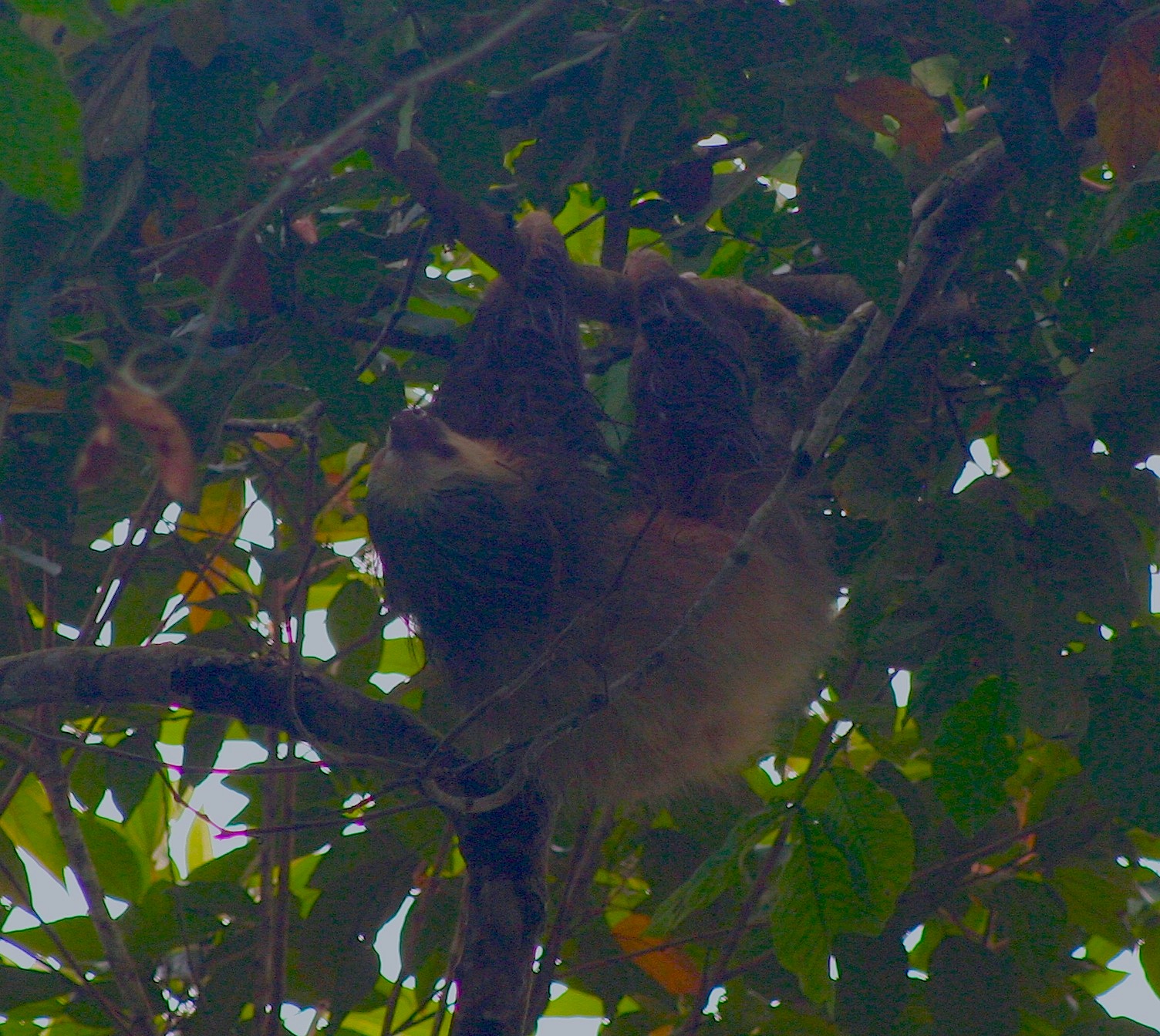
We saw a sloth right outside the La Selva office/headquarters/cafeteria. This is a terrible picture, but it's the best I got! I got better sloth photos last trip.


While at La Selva, we saw a troop of black-faced howler monkeys, including a mom with a baby! Not while we were in the canopy, but we did hear them up there. Again not a good photo at all, but it's all I could get!

This is the blue jean frog, a species of poison dart frog that is about 1 cm long! Tiny! We saw it on a hike through the jungle at the Organization for Tropical Studies' La Selva Biological Station.

We also saw a green and black poison dart frog. They are bigger than the blue jeans frog (which is only about 1cm long!)

We saw these adorable Honduran white bats (tent making bats) under a huge leaf at La Selva. 

A view of the rainforest canopy from above. 
The third day, we went to the Tirimbina Biological Reserve and Rainforest Center, which has a sustainable Cacao plantation on site, where they showed us how to go from the fruit (which is yellow) to the seeds, to the chocolate! 
They ferment the seeds, and then roast them in the sun, and then grind them and add sugar. We got to sample the cacao/chocolate roasted, with sugar, and as a drink with cinnamon. Yum!


This is the Sarapiqui River we crossed on a reallllly long suspension bridge to get to the cacao plantation at Tirimbina Reserve.
A cacao tree. For some reason the trunks arch! That's how you can tell them apart from other trees. Also the cacao fruit grows right out of the trunk! That trait is known as cauliflory.

As we walked across the long suspension bridge at Tirimbina, these iguanas were visible in the tree over the river. Massive tree iguanas: Whoduthunk it?

And a hint of what is to come next... this is a most beautiful sunset at Playa Grande on our second to last evening. This is the magical place where I had a most memorable two weeks in 1999 reporting on leatherback sea turtle nesting for Discovery Channel. Check out the archived Love & Death on Turtle Beach.

Wednesday, April 17, 2013

Growing Bananas (sustainably)!

Earth University's sustainable banana farm - block 2 - which we visited on our second day in Costa Rica.  Finca means farm, so Finca Bananera Earth means "Earth Banana Farm." All photos Copyright (c) 2013 Wendee Nicole


On day 2, Heidi and I visited Earth University, which I'd previously visited in Oct 2011 for the Planet, People, Peace (P3) conference (there are some other really cool images from that visit here). The next P3 conference is coming up in Nov, and I'm considering attending again! It was really cool. Anyway, this was a trip to report on agritourism and sustainable agriculture practices, as well as ecotourism and Costa Rica's efforts to become the first - or one of the first - carbon-neutral nations in the world. Imagine the US government having an official policy of trying to become carbon-neutral? Even if Costa Rica doesn't achieve neutrality by the deadline - and there are rumors already of the date being pushed back - it is a commendable thing in itself that they have the goal. And they are certainly making efforts. I will be writing about it for Earth Island Journal and possibly another publication. Below are some images, and a video, from the banana farm visit. Earth University is a fascinating place, and they are a carbon-neutral operation. 

This is Michelle Medina, New Business Developer for Earth University product division. The banana plantation is actually a for-profit venture, whereas the university itself is nonprofit. However, 100% of the funds raised go into scholarships for Earth U students. They have shown that sustainability can be profitable. Some of the bananas go to Whole Foods in the US. 
The bags protect the bananas from pesticides. The banana plantation is not organic, but they employ various techniques to reduce the use of chemicals and other problems associated with traditional farms. Inside the bags they put chile pepper and garlic to repel insects, rather than chemicals. The plantation is still sprayed with fungicides to repel an otherwise devastating fungus called sigatoka. They spray by airplane - using GPS to make sure it is only sprayed on the plantation - 3 of 4 weeks, and during the other week, the plantation is sprayed with beneficial organisms. By using these beneficial microorganisms, they have been able to reduce chemical use by 30%. There are also fears of a new strain of Panama disease, a former version of which wiped out banana crops in the 1980s. Because all of the bananas are clones of one another and hence genetically identical, they are particularly susceptible to epidemics...
The banana man leads the "banana train." In other plantations, workers carry or drag all the banana bunches! Earth U created this trolley system to improve worker conditions.

Another view of the "banana train."
A video of the banana workers processing the bananas from the bunches. First they're cut into smaller bunches and then washed. I believe they use chlorine in this process and water, but don't quote me on that!
Heidi and I with our sexy hair nets!

The foam inserts are removed and the blue plastic is removed and recycled. They make plastic terra cotta roof tiles from the banana bags that are used all over Costa Rica.
Bananas!
The workers cut the bottom bananas to test the ripeness. A "good" bunch will be white inside, and green outside, and they take about two weeks after cutting to ripen. if they are too ripe when cut, they cant be shipped to other markets so are either composted, or they are sold to local markets. This bunch - he told us - were too ripe. 


Once bananas come off the banana train, they get washed and then placed on the conveyer belt, where workers put them in boxes.
The ones on the left go to local (Costa Rica) markets, while the ones on the right go to Europe. 
These bananas - the best quality - are shipped to Whole Foods markets in the U.S. 
Earth University student Niyi, from Nigeria, showed us around the university's intensive farm operations where students learn various aspects of sustainable ag. I visited here also in 2011! This "vehicle" is now planted with crops! They demonstrate how to make use of any and all items that would otherwise go into a landfill. 
 
Niyi is a musician and you can see his cool Feliz Navidad (Merry Christmas) video from Earth University above!
A yummy cafe mocha from Earth University's Aroma coffee shop, made with Earth University coop coffee (CoopeDota carbon-neutral coffee). 


'