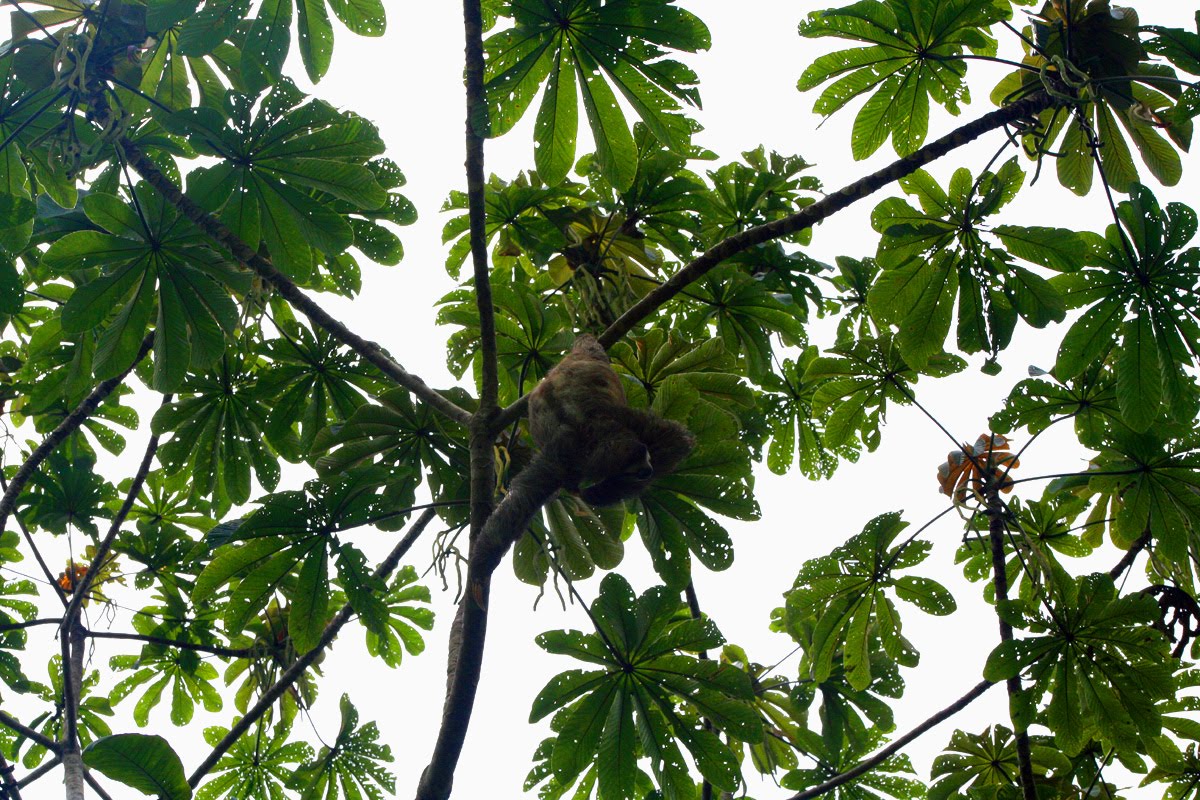
We left Earth University on Tuesday morning and headed for Selva Bananito Ecolodge, where we would be staying. We drove through the town of Limon, and there we stopped at a little city park where we saw not one but two two-toed sloths. They are not as active as the three-toed ones, and are smaller. The Caribbean coast has almost a Jamaican, Rastafarian feel to it, with the bright colors and many blacks who were brought over as slaves many years ago. But it's also the least developed area of Costa Rica. I found the city of Limon to be a bit dirty and crowded. Like a typical third world town, but much of Costa Rica is nicer for a traveler who wants that kind of thing. There's another town that we didnt get to that has a younger, hipster, cultural kind of aura from what I've read. We were just passing through on the way to the rainforest proper! Anyway the previous two sloths were way up in trees like the photo below, so seeing these up close was a treat!
 This is what most of the sloths we saw looked like - far away!
 This is a building in Limon. Apparently the Costa Rican government has recently invested money in improving the town but it hasn't started yet.
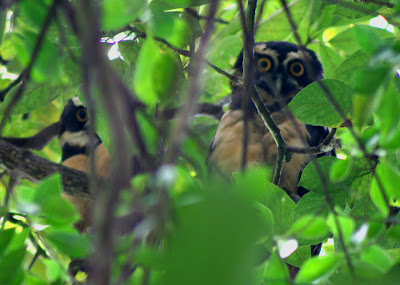 We also saw two owls in the tree in the park.
  A major earthquake in 1991 affected the coast, raising a lot of the coral reef beds out of the water.
 This sight cracked me up because I thought "even in Central America!" The kid has his butt hanging out of his pants. Like seriously dude, pull your pants up!
 Next we met up with Juergen Stein, owner of Selva Bananito Ecolodge along with his sister. He is a German born in Colombia who has lived in Costa Rica most of his life, and his father had a cattle farm and has over the years transformed a small part of the ~3,850-acre property into an organic banana farm first but later (because the organic banana market didn't do so well) an organic palm oil plantation. However, 75% of their property remains as virtually untouched forest, and some of that 25% that isn't forested is being reforested as a carbon offset project. This is the road heading to Selva Bananito. The family started a Limon Watershed Foundation to help improve the local watershed, which was negatively affected by the earthquake.
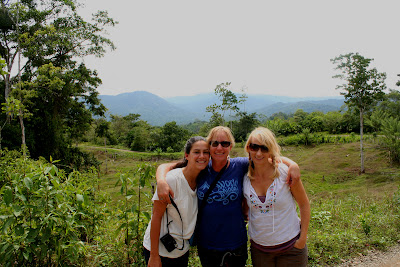 Paula, Elizabeth and I on the way to Selva Bananito!
 A beautiful creek on the way. I'm not sure what this is - maybe it is the Bananito River.
  My photos could not do the Selva Bananito bungalows justice! They are gorgeous! (Click this link to see more images - it's their new website, which is only in German so far - the other link is to their older version which also has tons o' info) The wood for the bungalows is made from trees that fell naturally, and the roof is made from recycled banana bags (they put blue bags around the bananas to keep insect pests out).
 It's all open and you sleep with the jungle sounds all around you. The mosquito nets actually aren't even necessary - there's not really malaria or anything here - it's more of a decorative touch, though some people feel like they prefer to have it around them.
  Each bungalow has two beds and two hammocks. So amazing!
 This is Sofia, Juergen's sister. She is married and they have a son who was out at the lodge. They live near San Jose, the capital city. Juergen mainly runs the lodge, among many other amazing things he is doing. He pioneered the Climate Conscious Traveler program, where travelers to Costa Rica can offset their flights (or the travel agency or the lodge can do it for visitors - which is how it started). It's a very new program and the ICT (Costa Rican Tourism Board) has taken the project to help spread it far and wide. Selva Bananito has 5 leafs, the highest certification possible. The only electricity is solar and at night, dinner is served by candelight.
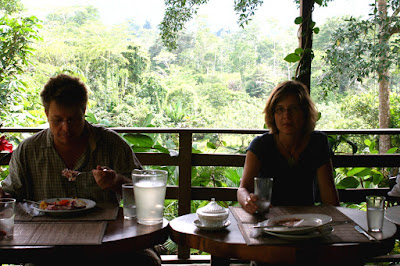 We had a delicious lunch! This is the dining lodge and the photo isn't great but you can see the absolutely stunning rainforest in the distance. There's also a little lake where caimans live and we shone the spotlight at night and saw their glowing eyes.
  Leaf cutter ants are everywhere in Costa Rica! They have these in Houston too but I love them and they are literally everywhere you step. My friend's daughter once called them "Salad ants" (because they carry the vegetation on their backs and it looks like they are carrying salad) and that always stuck in my head). They make trails and are working night and day.
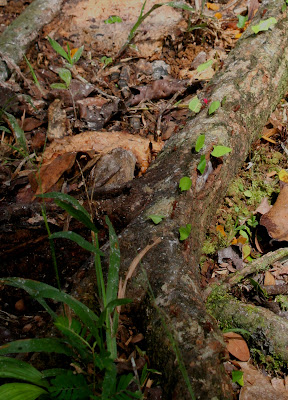 Leaf cutters walking along a tree root.
 And along a path on the ground.
 As soon as we unloaded our luggage into our bungalows, we got on horseback and rode a short way down through some pasture and near a reforestation area and down to the rainforest. The property owned by the Steins and Selva Bananito borders La Amistad International Park which is the largest park in the country and takes up like 20% of the entire national area if you look at it on a map - it's massive! It also goes into Panama so is an international park, and a UN Biosphere Reserve. On the left, the roots are from the palm tree that they harvest hearts of palm ("palmito") with. Unfortunately I didn't get my Arroz con Palmito meal while there, but I am hoping to find a recipe and make it myself sometime. I now have plenty of Lizano Salsa!
 We were walking to get to a zipline, but on the way our guide Justo told us about the rainforest and its ecology (of course, having studied rainforest ecology myself I know a lot of it but the others didn't as much). He knew a lot and was great. We also saw a ton of poison dart frogs - little, tiny red ones (not sure the species), and larger green and black ones (called, the amazingly creative "green and black poison dart frog").
 Paula, Elizabeth, me and Freddy from ICT near a big tree right next to the zipline platform.
 I have to admit, I was really scared to do this! I thought maybe it wouldn't be that bad but... it was so high and so new. I can dive with sharks any day over this! So everyone went across but Juergen was so sweet and he went across with me.
 I don't know if you can see the look of terror on my face?! The image is blurry, but the look of terror is there. LOL! Honestly, it went very fast, and was fine but the worst was yet to come! There was a rope to rappel to the creek below - 100 feet down! I took one look and was like no way in hell! I really wanted to, but I couldn't. Juergen went straight down (he abandoned me!) and Paula made it look so easy, and then Elizabeth went and said it was a bit scary but... I just couldn't. So the only other way out is another zipline so I did that with the guide, Justo. I wanted to cry, I felt like such a loser... but it was genuinely frightening to me. I would like o go back and overcome my fear (I did it with airplanes, I know can do this...) but part of me is like, why the hell would I want to rappel down a rope that far in the sky! Ha ha!
 A giant buttress on a giant tree! After our adventure sports, we rode the horses back to the lodges, showered and met up for a delicious dinner of local cuisine by candlelight - but first Juergen gave a talk on the lodge, on their efforts with creating a watershed protection nonprofit for the Limon Watershed, and other work. It was Paula's birthday, and they made her a special cake! We also each got a special drink - coconut milk and Coco Loco served in a coconut. Such a truly fun and wonderful evening.
 After our wonderful night the next morning we had to leave. I actually got up early to bird-watch and we saw a ton of species including an aracari toucan, keel-billed toucan, short-billed pigeon, masked tityra, slaty-tailed trogon, white-necked jacobin (hummingbird), yellow-chested kingbird, clay-colored robins, spectacled owl, and several oropendula (big black birds with large bills and they make really cool nests). Besides the toucans, my favorite was the snowy cotinga - this pure white dove - just gorgeous! We also stopped by the lake and saw a little caiman. I didn't bring my camera but we walked along the pasture as it is easiest to spot birds along the edge of the forest.
 We next went snorkeling off Cahuita Point! It was cloudy so the water wasn't as brilliant and I didn't take any photos but it was pretty cool - not the best snorkeling I've ever done for sure. But it was cool and then we went to lunch at a local lodge, Suizo Loco, where there was the most amazing three-toed sloth right close! The three-toed species are more active so it would move all around and I got some photos. I'm in love and want one! Enjoy the photos.
  This is one of the sloth's favorite trees, a Cecropia tree.
 Just hanging out!
 While eating, we also saw this blue-gray tanager as well as some other birds.
  Bananas!
 We then drove 5 hours back to the Finca Rosa Blanca ecolodge, outside San Jose (It wouldn't have been that long but we stopped a few times). It is absolutely stunning architecture and I'm really bummed we didn't get there before dark, because it has an organic coffee farm along with the B&B. We had met the owners, Teri and Glenn Jampol, at the Planet People Peace conference and Teri met us for dinner in their restaurant which was 5-star dining and local, organic, sustainably harvested ingredients - many grown on site. Since we had to leave at 415am we also didn't get time to see it in the morning. Next time for sure!! I will leave you with this lovely photo of my favorite animal - the oso perozoso (means lazy bear in Spanish). :)
But wait - there's more! I just discovered the cutest video I have ever seen in my life (especially since sloths are my favorite animal - along with mountain gorillas) so check this out - it was from this Treehugger article!