Monday, June 21, 2010

Bering Sea Day 5/6: Short-tailed albatross & missed opportunities

An endangered short-tailed albatross. There are only around 2,000 left in the world. I saw one today! You cam kind of see some of the swells we've been experiencing too.
Copyright (c) 2010 Wendee Holtcamp


Is it only day 6? I feel like I've been here forever. I'm getting pretty homesick already. I did not do much today, to be honest. Yesterday that storm came, but it wasn't the kind of storm I was thinking of. It was gale-force winds, grey skies and a bit of drizzle. In fact it's still going on. And even more in fact, I was told that this may last another 2 or 3 days. We have 8-10 foot swells, with an occasional 12-15.

The boat was rocking and rolling pretty good last night and I wasn't the only one thinking (and praying) that hopefully the boat won't sink! I am in the top bunk so wedged a pillow on the side so I had something protecting me from falling right off. I finally was able to fall asleep but then I'd get woken up by the crazy waves, slamming against the ship. The amazing thing is that I didn't take any medicine but didn't get seasick! One of the crew members, Terrence, told me the first day to wean myself off the medicine because my body would get used to the motion naturally. So I did that, and it seems to be working.

It seems I'm always in the wrong place to see the cool stuff on this trip. Snrises and sunsets are rare out here because there are almost always clouds, but this morning at around 6am there was a gorgeous sunset. My roommate Diane graciously allowed me to use this photo below to show it off. Wow! Also, they saw some Dall's porpoises off the boat today. But what I did see is... drum roll please.... a juvenile short-tailed albatross (Phoebastria albatrus)! There are only around 2,000 left in the world and they all nest on an island - Torishima - in Japan. I took a couple very bad photos, but one of the guys on board, Greg, got some great shots from the spring cruise and he also is allowing me to use them. And last, Colin let me put up some of his very cool photos of the storm. So... I can't say that I took a lot of pictures the last couple days but I'll share what I have: others cool photos!

Instead, have been working on the computer all day, finishing up some critiques for my online writing classes I teach (next one starts July 24!). I also got Skype set up so I can start recording podcasts for the next Wendee Holtcamp Report on Adventures in Climate Change. I've been recording snippets of video here and there also, and my editor may get weave her magic to put them together into something interesting. That doesn't sound like a whole lot. Where did the day go? We had a delicious peanut sauce, pasta, and stir-fried veggies tonight, and pineapple upside down cake with fresh whipping cream. Yum!

Right now we're at a deep station, and that means I am going to stay up until 2am, because it's a good spot to watch the scientists pull up the Bongo drums at night (something I have not yet seen) because the krill bioluminesce more at the deeper site for some reason. I will have to check on that one.

Meanwhile go check out my 2nd installment of the Bering Sea Project reports on Nature's The Great Beyond blog... And I leave you with more photos - some mine, most others'!

The absolutely stunning sunrise that I missed! Photo Courtesy of Diane Stoecker.
Another shot of this morning's sunrise (that I missed) - Photo Courtesy of Diane Stoecker.
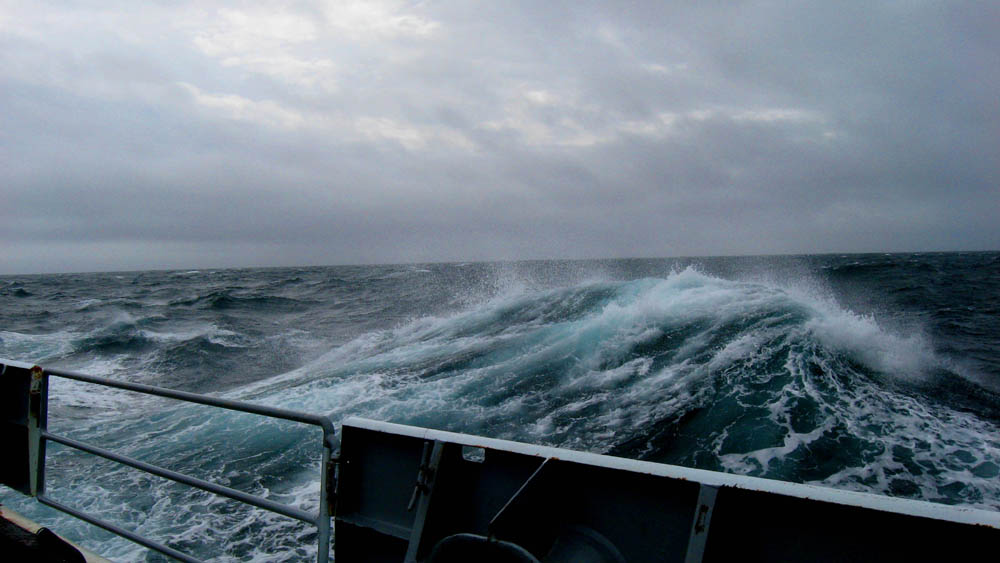
Another shot of the big swells! Photo Courtesy Colin Smith.
The waves crashing on the fantail/back deck. Photo Courtesy Colin Smith.
Photo Courtesy Colin Smith.
A close-up of the albatross - not a super great pic but it's all I could get through a window and with it far away.
A shot of the albatross taking off on the water. I think it's cool you can see the tracks it left in the water when it "ran" on the water to take off.

Sunday, June 20, 2010

Day 3/4: Living on a Ship

Song of the Blue Ocean... the Bering Sea
Copyright (c) 2010 Wendee Holtcamp


I've been at sea a few days now, so thought I'd give an update on life on board the R/V Thompson. It's been pretty smooth sailing but today the winds got kicked up a bit and we're rocking and rolling. Not so bad - it definitely could be worse. Yesterday one of the scientists told me the NOAA forecasts were for a big storm with 12-foot swells and 35-knot winds in 24-48 hours and so I had to ask around to make sure that was really true! I asked Captain John this morning and sure enough there is a storm forecast in the area, but not for around 96 hours. But we all know weather forecasts.

My first blog post went up on Nature's Great Beyond blog, you can read it here. The next one will be up Monday UK time, whenever that is! You can also just bookmark this link and it will display all my blog posts on the Bering Sea at any time.

Overall things are going great! Everyone is really nice, and the food is really tasty and there are lots of fresh veggies and salad stuff and vegetarian options, even. There is a ton of snack food around, from Lorna Doon shortbread to M&Ms to coffeepots always on, hot cocoa mix, tea, and leftover desserts from the earlier meals, and fresh fruit. Breakfast is at 7am, lunch at 1130am, and dinner at 5pm. Scientists work night and day, and during my waking hours I spend time talking to everyone, taking pics, editing pics, writing my blog, and doing other miscellaneous stuff.

A lot of experiments are taking place on board now, which is pretty amazing. In fact it's day 5 and I've talked to nearly every scientist on board but I still keep learning about new projects and new equipment! This morning Jessica Cross showed me the flow cytometer that takes constant readings of the ocean water as we cruise over it. I didn't even know about it before then. Yet it's a key piece of equipment on board.

Everything seems to take forever to accomplish on the boat for some reason. Maybe because there are doors every five feet, and you have to open and close them constantly, and there are several levels, and some things are up and some things are down. So it takes time to get to your room to go to the bathroom, then back downstairs to the labs on the main deck or out in the back where most of the big equipment goes down to measure water, mud, and critters. It takes time to get your rubber boots on, and your orange life vest and hard hat on - mandatory for going out on deck (especially if equipment is being hauled around). That's just life on the boat, I guess.

Most of the scientists have a 'space' in one of the labs on the main deck but being the journalist on board I don't really have a space. I kind of float through, talking to people, roaming around. I think I feel less seasick in the library. It's like a big conference room. Maybe because it's a large room? So I've been working in here. I haven't gotten too seasick actually. I didn't use the patches I bought because Nancy Kachel, the co-chief scientist warned me they would make you feel freaky! That scared me off them. I used Bonine, and took 1 pill, then 1/2 pill then no pill yesterday. Today I took one because I started to feel queasy after lunch with the boat going crazy.

I got my laptop wired to the outside world so despite my initial fears (or hopes?) I am not disconnected from the internet. But it goes on and off constantly. If the boat faces southwest, it goes out. So there you have it - are a few random thoughts about life on board a boat. And now, I'll leave with you some pics of life on the boat...

This is my very small "stateroom." It has bunk beds - I'm on top - a sink, a desk, some storage lockers (which include our Gumby suit and lifevest for emergencies). I share a room with Diane Stoecker, an environmental science professor at the University of Maryland.
Another view of the room - the grey cabinets/storage lockers are on the left.
We share a bathroom (toilet and shower) with an adjoining room. The showers are teeny tiny (left of the toilet) but the most important thing... they have hot water! Boats desalinize water so there's an ample supply.
Doors, and stairs... doors, and stairs... these are very common on this ship. The doors are for fire protection/safety.
Chef Steve with the nightly dinner buffet!
This is where everyone eats - scientists, crew, etc.

This is the big library where I have been working. Sometimes I work at the desk in my room too.
The computer lab on the main deck. My room, and the mess hall are one floor above the main deck.
I worked out today for the first time. I am proud of myself! Not that many people work out on board, and I'd been in sort of a no-workout-mode right before the trip because of the insane busy-ness. I'm back on track, and my workout partner Elise would be proud.
Here's a boat's solution to weights rolling around... make them square.
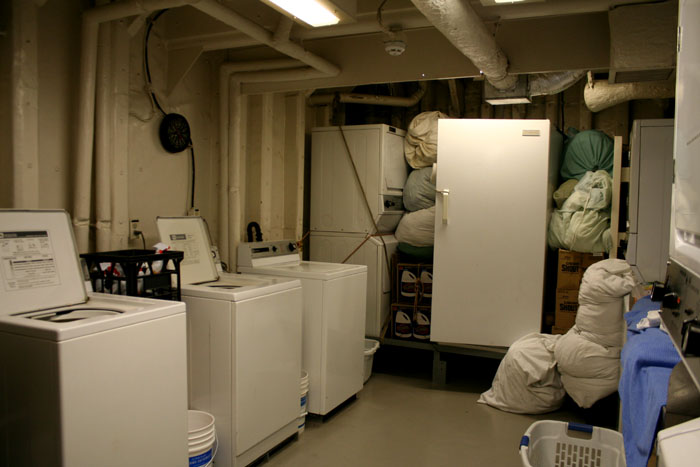
The laundry room! This is 2levels below the main deck, in the bowels of the ship. We get assigned days to do our laundry.
And some more shots of life outside the ship. Ebett Siddon, a grad student at University of Alaska-Fairbanks (Juneau) holding a lion's mane jellyfish. This creature lives only one year, and the largest ever found had tentacles longer than a blue whale. That makes it the world's largest living animal.
Colin Smith making a mudpie... (It's a pretty nice one if I don't say so myself). This is a sediment core hauled up from the ocean floor and they slice it up for processing. David Shull is studying nutrient exchange between the overlying water and the sediment.
I was so excited for just a few hours of sunshine and blue sky yesterday so I took some pics (that's the moon in the top right quadrant), and I had a brilliant idea to stay up and watch the sunset. Sunsets out here are reportedly gorgeous, but since most of the time it's cloudy, gray, foggy, you don't see them often. Unfortunately it clouded up by 12:30am when the sun finally went down. As someone on board the ship joked, sunset usually means the clouds turn from gray to darker gray.
And here's a shot of that foggy grey lack of horizon we often see. This is Alexei Pinchuk (from University of AK Fairbanks) setting out his Calvet net over the starboard (right) side.
There are some "cold rooms" and isotope labs on board the ship (they stay around freezing temp). This is Greg working on David Shull's research in the cold room. Those are sediment cores taken from the sea floor, stirring gently with a magnet. Greg takes readings on oxygen level every day for about 4 days, until the oxygen gets depleted.
Another shot of Greg in the cold room.
Until we meet again, I'll leave you with another shot of the blue waves in the Bering Sea today...

Friday, June 18, 2010

Day 2: The Tools of the Thompson

The R/V Thompson will be at sea for 28 days during its "summer cruise" which I'm on. During that time, it stops every couple hours at one of a couple hundred 'stations' along 10 or so transects - lines in the ocean along which the scientists want to stop and collect 3 main things: water, mud, and bugs. OK they're not really bugs but it sounded good. They collect living stuff - more below.

The first thing they do at every stop is to collect water via the CTD (stands for Conductivity, Temperature, and Depth). Later, I will tell you more (via the Nature Great Beyond blog...here maybe if you're lucky) about what they measure in the water, and why. Co-chief scientist Nancy Kachel is the "hydro team leader" but there are many groups on board that need water from the CTD for their varied and sundry experiments. Data is actually collected right from the water in the CTD which goes directly to a computer server on board the ship, which is immediately shared with all others on board who need to access it. They can collect water deep, or at various depths, depending on the scientists' needs.
After the CTD, the actual order of events next varies by station, but let's just say next they deploy the multi-corer, which collects sediment (aka mud usually, sometimes sand) on the ocean floor. They drop this baby all the way down and it fills with muddy gunk, trapping everything inside, including the living organisms.
After the haul it back on board, techs (here Rachel and Colin) get the mud from the Multi-Core into tubes that can go to the lab, with Dr. David Shull, the ship's chief scientist, looking on.
After most of the tubes from the Multi-Core go to the tubes for the lab, they have to slice n dice some others for other purposes (again you'll have to wait for my Nature's Great Beyond blog posts for details!) Here Greg (left) is handling the tube for the lab, with David on the right.
Last, they deploy the MOCNESS (Multiple Opening/Closing Net and Environmental Sensing System). It has 9 long tapered nets on a rectangular frame. I love its name! Sounds like the Lochness aye?

They deploy this giant net that off the boat's fantail (back end) and then start motoring very slowly with the MOCNESS dragging behind the ship for ~30 minutes, collecting all living things in the vicinity (mostly very tiny stuff like krill, copepods, and baby fish or icthyozooplankton).
After they're done, they haul it back on board, and spray off the stuff into buckets, which they bring into the lab. More to come!

Thursday, June 17, 2010

Bering Sea: Day 1 -Dutch Harbor

Coming in for the landing at Emergency Field, Unalaska (aka Dutch Harbor), Alaska - cutting it close to the mountains! It's a short runway and they have to gate off the main road in town when planes land.
The final landing! The plane broke hard.
Flags at the airport. Alaska renamed it Tom Madsen airport after a bush pilot who lost his life but the FAA still calls it Dutch Harbor/Emergency Field.
Sean and Nancy in the car driving to the boat from the airport.
A shot of the R/V (Research Vessel) Thomas G. Thompson in port in Dutch Harbor
Another shot of the Thompson.
A fishing trawler next to the Thompson in port. Dutch Harbor is the biggest fishing port in the U.S., and the Bering Sea brings in half of the US' catch of commercially caught seafood.

We went out to eat at the Unisea restaurant and pub - this sign was on the door. I am pretty sure that Deadliest Catch shows the place now and then.
The beer I had, which was fantastic!
A shot of some wildflowers and the mountains in the distance in Dutch Harbor, Unalaska.
Right before we left this amazing rainbow appeared in the sky - a good omen I hope! Only when I enhanced the color a bit did I realize it's actually a double rainbow! If you look close you can see the second faintly above the other.
A shot as we left Dutch Harbor around 2100 hour (11pm). The waters got pretty wild that night!
Another shot leaving Dutch - next shots will be of scientists working on board!

Sunday, June 13, 2010

Where to find me... the Bering Sea

Mountains in Glacier National Park, Montana
Copyright (c) 2007 Wendee Holtcamp

Just wanted to post a quick update: I leave in the morning for my next big adventure - a month on a boat in the Bering Sea (see the more detailed post below). You can follow my adventures at Nature's Great Beyond blog - http://blogs.nature.com/news/thegreatbeyond, where I will be posting dispatches once or twice a week. Post comments or questions - I love to get feedback and comments on my blogs while traveling!

I'm excited that tomorrow, I'm going to spend 6 hours on my layover in San Francisco hanging out with my friend Zofia (mom to my beautiful niece Kira), and then around 347pm, I fly to Anchorage and will stay overnight with a journalist friend there. I leave on Tuesday morning for Dutch Harbor on Unalaska Island. Then the ship itself leaves Wednesday sometime in the afternoon, depending on weather.

I don't know how internet will be on board so my first priority will be getting those Nature blog posts in, so check there first! After that I'll try to tweet a bit here and there. I brought with me: rubber boots, rain jacket (it's supposed to mostly rain...), Barry Lopez' Arctic Dreams, lots of music on my MP3, binoculars, and a Bird Guide to Alaska! Among other things.

Also during July keep an eye out for the next annual Texas Parks & Wildlife Magazine Water issue. I have a feature called "Saving Land, Saving Water" (based on our recent trip to San Antonio and the Hill Country) and my daughter has two photos published in it! You can usually get it on the newstands, in Texas at least, in mid- to late June.

Not long after I return, a colleague and I are taking the Great Gulf Coast Road Trip to check out the effects of the oil geyser on land and sea, from Texas to Florida to report another couple of stories. It will be a busy and fun summer!

Friday, June 04, 2010

Heading to Unalaska!

Copyright (c) 1997 Wendee Holtcamp
This shot of an adult moose in Alaska was a print photo I scanned years ago pre-digital, and so I apologize about the quality. I have boxes and boxes of slides that one day I plan to get some of online. That will include the amazing shots from my month in Alaska back in 1997 when the kiddos were little (my ex and I drove there on the Alaska Highway).

It's 2:20am, and I suppose I should be asleep, but I actually love working late (or early as the case may be). Every night over the past week I've wanted to update my blog, but have been either too tired, or too busy.

The most exciting news is.... drum roll please! In a couple weeks, I will heading to the Bering Sea on board the R/V Thompson, joining a group of scientists on the Bering Sea Project, a joint project of the National Science Foundation (NSF) and the North Pacific Research Board (NPRB). I applied for a spot on board, and got accepted as the sole journalist. In fact, I applied for the earlier trip in May, but only got a couple days notice that I was selected. So... after much mental wrangling - should I give up a chance to cross walruses off my bucket list or just go at a moment's notice? - I declined. I still hoped that I'd be selected to go on the next leg, and sure enough I was! With several weeks notice this time, I accepted, gladly.

So the flights are booked, and I'm getting all ready to go! I'm very excited to see a land that I've imagined since my childhood. One of my favorite childhood books was Island of the Blue Dolphins which I remembered as being based in the Aleutian Islands, but although the Aleuts are part of the story my memory was wrong. There is an Aleut tribe that comes to the island and I suspect there's some backstory there that is what I remember. I have checked it out from the library and plan to read it again on the boat.

Regardless, the book made me dream of this far away locale way back when, to imagine what it would be like, and now i get to see it firsthand. I also think that walruses are one of the all-time coolest animals, so despite the fact that most ice floes will be melted by mid-June, I am still hoping I may spot some swimming in the cool waters.

Another interesting fact is that I fly into Dutch Harbor, the town where the crew of the Discovery TV series Deadliest Catch are based. I don't have cable TV (I don't watch TV generally) so I had never seen the show so I watched one episode at my boyfriend's place, and it was interesting. It was cool to see how at the beginning of every show they depict Dutch Harbor on a map. The thing that cracks me up about this town, on the island called Unalaska about halfway down the Aleutian Island Chain, is the name of its airport: Emergency Field. Click on that link to Unalaska to see an absolutely stunning landscape. Also you can read about the blog of the lead scientist on board the current leg of the trip here. And I will be there in less than 2 weeks! From there the boat will go through the Bering Sea, stopping to take data on various aspects of the ecosystem, and we will end back where we started a month later.

In other news...

I now have my own blog called.... another drum roll.... The Wendee Holtcamp Report! It is a monthly blog on the Adventures in Climate Change website and it will focus on positive stories such as research and innovations by scientists, nonprofits, individuals and governments working to make a difference to curb global warming. My first article for them was the Shrimp & Oil Really Do Mix? piece on the oil spill, which was posted before I had my own forum. My latest post is called Time for a Sea Change: Can the Oilpocalypse spur lasting change, or will it just be another environmental disaster?

I just finished an article near and dear to my heart that touches on food choices, factory farming, vegetarianism. I will post some links to some of the reports that I read, which everyone should read! But not tonight. Next time!