Showing posts with label cyanobacteria. Show all posts

Tuesday, January 10, 2012

Did Tap Water Cause Lou Gehrig's ALS?

Yellowstone's Grand Prismatic Spring - colored by cyanobacteria.
Copyright (c) 2011 Wendee Holtcamp


I wanted to mention my latest article in Miller-McCune Magazine - a story I am particularly proud of - not only because I think it's a compelling and interesting article, but because the topic is one that I've been following for a long time and it has important implications for human health. I first met the subject of the article, Dr Paul Cox, when I was a graduate student in Ecology & Evolutionary Biology at Rice University when he gave a seminar there in 2004 on this topic and I was thoroughly wowed. Any story that involves fruit bats, pond scum and brain diseases has gotta be good, right? Paul is also a great guy, very passionate about helping people and the planet, a fantastic writer (check out his book Nafanua: Saving the Samoan Rainforest) and really a brilliant man.

In a nutshell - neurotoxins produced by cyanobacteria ("blue-green algae") may be causing neurodegenerative diseases, like ALS and Alzheimer's. Yep that's right! Read the story - you may not want to eat shrimp and crabs much longer! I wrote another article on this subject in 2009 for Texas Parks & Wildlife magazine - Blue-Green Mystery - and I have one coming soon on the topic for Environmental Health Perspectives (just turned it in - love that feeling!).

I hope this story helps bring more awareness to this important subject, which certainly merits more study and attention. And remember when I visited Yellowstone and Jackson Hole, Wyoming to report the story last September? So go read it, comment, Facebook it, Tweet it, and you will make me a very happy camper! Let me know what you think!

Was Lou Gehrig’s ALS Caused by Tap Water?


A toxic molecule found in pond scum may trigger neurodegenerative diseases such as ALS and Parkinson’s. Could a group of scientists, led by a botanist, hold the key to a cure?

The story begins...

Rudyard Kipling called it “Hell’s Half Acre,” a geothermal wonderland where people could fall through the Earth’s thin crust or be poached by steamy hot springs and geysers. Most visitors to Yellowstone National Park’s Midway Geyser Basin stroll the wooden boardwalks, but a few hike a short, steep side trail that reveals a bird’s-eye view of the entire valley, including Grand Prismatic Spring, which can be fully appreciated only from above. Mustard-yellow and vibrant-orange mats spread like tentacles from the turquoise pool. “Not even the most talented artist could imagine something as beautiful as that,” muses Sandra Banack, a biologist who studies cyanobacteria, the microbes that create the colorful mats — and that hold a toxic secret.

Click over to continue reading!

Friday, September 16, 2011

Yellowstone National Park - hot springs and cyanobacteria!

Grand Prismatic Spring with Excelsior Geyser bubbling in the background - Midway Geyser Basin, Yellowstone National Park, Wyoming. Copyright (c) 2011 Wendee Holtcamp


For a charm of powerful trouble,
Like a hell-broth boil and bubble.
Double, double toil and trouble;
Fire burn, and caldron bubble.

- William Shakespeare


This week I went to Jackson Hole, Wyoming to spend some time with Dr Paul Cox, founder of the Institute for Ethnomedicine (among other things - a very interesting and accomplished scientist he is!). This is Paul in the lab looking at some Phormidium under the microscope - a cyanobacteria or blue-green algae. You can see it on the computer screen. I'm writing an article about his work on BMAA, cyanobacteria and Lou Gherig's disease (ALS - Amyotrophic Lateral Sclerosis).
On one of the days, Cox's colleague at the Institute, Dr Sandra Banack, took me to Yellowstone - and this is related to the story! She showed me a little known waterfall, Moose Falls, not far off the road (You can view photos from my last trip there, in 2009 - to the Lamar Valley, Mammoth Hot Springs and more - when we saw wolves and bighorn sheep!)
Ah, so lovely! We went on this steep but short hike to a ledge overlooking Grand Prismatic Spring - the largest hot spring in the U.S.! A stunning view isn't it? Apparently not a lot of people know about this trail. You get a much broader/better view than on the boardwalks. We ate lunch up there. This is a view of the Excelsior Geyser beyond in the distance, which wasn't gushing at the time, only bubbling. It is very steamy, but close up the water is just gorgeous and looks like the Caribbean with coral reefs! It discharges 4000-4500 gallons of water per minute! Oh and the entire Yellowstone National Park practically lies inside a giant caldera, or the rim of a volcano. And with 65,000 years or so since the last eruption, we are due for another. Sandra was kind enough to check the earthquake levels for me... I didn't ask! A side view of the different colors in the pool. And guess what makes the yellow and orange colors? You got it - cyanobacteria - one of the most ancient organisms on earth. The orange is actually made by... Phormidium! The same species Paul was looking at in the lab, which he gathered from a wetland in Logan, Utah. Sandra tells me that underneath the orange mat it is green. They are photosynthetic organisms. Not sure why they get the orange top coat - will have to find out. The yellow is from the cyanobacteria genus Synechococcus and they live in hotter temperatures. A close view of the Phormidium mats in the Grand Prismatic Spring

Sandra on the boardwalk near Grand Prismatic
This is a really close up view of the Phormidium cyanobacteria.
I'm actually not sure where I shot this but it's more mats of cyanobacteria.
On the side of Excelsior Geyser - looks like the Caribbean doesn't it? Or maybe a hot tub in the Caribbean!
Another view of Excelsior
Near Grand Prismatic and Excelsior lies this beauty - turquoise pool - reflecting a drop-dead gorgeous sky!
Me standing in front of Opal Pool. Having come here many, many times, Sandra was surprised at how small it was compared to Turquoise pool and suspected something in the water under the earth must have shifted.
This was taken out the car window! The bison walked right by our car. Of course I had to stick my head/hand out the window to take a photo. It was a little disconcerting to be that close to a bison...
The photo makes it look almost like he is missing a limb but he's actually walking. And yes, it was a boy. I looked.
We took a 1.6 mile (each way) flat hike to Fairy Falls. I didn't see any fairies though. Darn!
The mountainside was steep but Sandra darted right up. She's used to trekking the mountains of Samoa, Fiji and other places looking for bats, and other things. Evidence of the massive 1988 fires is everywhere - notice all the downed trees?
She pointed out the many edible berries on the mountainsides this time of year. These are Saskatoon berries and we had some, as well as wild raspberries and huckleberries.
I liked this view of the whorls in this dead tree, plus the new life coming through.
And of course we had to stop by and see Old Faithful. This was my fourth visit to Yellowstone, but I hadn't seen it erupt since I was a kid of 14. We had stopped here while moving from Portland, Oregon to Minneapolis, Minnesota. This is pre-eruption. Old Faithful will start putting out some steam. A lot of people had gathered around. We actually arrived about 20 minutes before it's eruption, so perfect timing!
And thar she blows!
On the way out of the park we saw a couple of elk in a meadow. We looked but didn't spot any moose or bear or wolves. Bummer!
A closer view of the two elk.

Wednesday, March 04, 2009

nightmare - interpretations pls?

Mountain Lion
Copyright (c) 2007 Wendee Holtcamp


I haven't really felt like blogging lately and I'm not sure why. I haven't journaled much lately either. The last week I worked on an article I'm writing on the link between cyanobacteria blue-green algae) and Alzheimers and other tangle diseases (ALS, Parkinsons etc) so named because of the presence of neurofibrillary tangles in the brain of victims. Tangles are just what they sound like, nerve cell tangles inside the brain. Back in the 80s, I think, there was a minor panic over the use of Aluminum pans when scientists found Aluminum bound up in these tangles but that turned out to be an effect rather than a cause.

Well now scientists have isolated a neurotoxic compound, BMAA, that is produced by cyanobacteria of various species found all over the world. The scientists at the Institute for Ethnomedicine, led by Dr. Paul Alan Cox, believe this could be the culprit in the tangle diseases and they have explained a mechanism for how it could work. They've published many intriguing papers and if it pans out they could very likely get a Nobel prize.

The frightening aspect is that cyanobacteria are found in our drinking water supplies and while their acute toxic effects on animals and sometimes humans have been known for a long time, this BMAA apparently (according to Cox's theory) can lead to Alzheimers from chronic exposure to even low levels, probably in genetiaclly susceptible individuals (for example we know of genes making people more vulnerable to breast cancer, or lung cancer, etc).

It's fascinating stuff. I wrote about this a little bit back in October when I was mentioning how sand mining on the San Jacinto River because the increased turbidity leads to more cyanobacteria, particularly in dry years. (see sand mining could be toxic). My article will appear in the July issue of Texas Parks & Wildlife magazine.

I finished drafts of my first 5 chapters in my book, which feels good but I have much more to go and not much more time! That is kind of stressful. In the next month and a half, I have a feature article due, and a talk to give at my son's school on the benefits of forests and trees. That on top of the need to get a couple more chapters of my book done... And on a personal level I just feel drained. I feel a bit angsty and uncertain and I'm not at all good with uncertainty.

So on a side note I had a weird nightmare and am curious what you all think about interpretation. I was at my house but my house was in a prairie without other houses around. In the distance some bison were charging at some people there and it was a sense of panic, because some guy was going to get slaughtered by this beast but it was in the distance, so I ran toward my house but as I got there saw a bison there close by. My Subaru was parked in the driveway, and as I approached the bison which had initially just been standing there got mad and started charging towards me or the car. I climbed into my car but there was a guy (who I didn't know) behind the car screaming because the bison was charging straight at him and I screamed to him to open the back hatch and he tried but the bison then rammed him into the back of my Subaru and of course at this point my heart is racing and I'm in a total panic because this guy just got killed or something right outside my car. Then I woke up.

The weird thing is the longer I think about this dream, I think I've had it before. And not only that but I used to have a recurring nightmare as a child that a wolf (or wolf pack?) was chasing me across a field and I couldn't run or run fast enough but it never "got" me. It almost seems like the dream of my childhood has returned but in slightly different form in a weird way. I also have to laugh that wildlife are even in my nightmares! Ha!

Sunday, October 19, 2008

sand mining could be toxic

Copyright (c) 2006 Bryan Carlile/Legacy Land Trust
Sand mine on the San Jacinto River, Texas


I had two of my daughter’s teenage friends over here spending the night last night with her, and we were talking about the upcoming election and watching the recent Saturday Night Live skits with Tina Fey and Amy Poehler, and I asked them – since their school is doing a mock election coming up – who they would be voting for. I assumed they’d probably say McCain because I know that both of their parents are Republicans (what can I say – I live in Texas). But when I asked, “Who are you going to vote for?” one of them replied, “Chicken Nugget” and the other replied, “Bob the Builder.”

These are smart kiddos, they are. And witty too. They cracked me up! One of them said they asked their dad for an unbiased explanation of the election but he didn’t give her one. I thought that was pretty smart of her to be able to even recognize that it was not an unbiased explanation! I told her that she can go to CNN.com that has a pretty decent explanation of each candidate’s positions on various issues, and voting records. Heck I figured their school should be giving that information, since they’re having a mock election!! I may just have to have a talk with their teachers.

I’ve been working on a talk I'm giving next Thursday at their school about the San Jacinto River and the impact of sand mining. I am the Founder of San Jacinto Conservation Coalition, a nonprofit organization that co-nominated the river as an American Rivers Most Endangered River, and it was selected as one of ten in 2006. Sand mining devastates both the east and west forks of the river, which is a historical and ecological treasure. The infamous battle cry, “Remember the Alamo” was cried out on the banks of the San Jacinto. And the river is lined with bottomland hardwood forest, which provides habitat for nesting bald eagles, migratory songbirds, and many other wildlife species.

The sand mining is so horrendous that Harris County Precinct 4’s Dennis Johnston told me:

“Sand pits from the air are 10 times worse than what they look like on the ground. They totally dominate the landscape along the San Jacinto River. It looks like nuclear war was practiced in this theatre. The silt drainage they were pumping into the river was so obvious that it looked like cream running into a fresh poured cup of tea.”


This is a photo I took of the illegal dumping of sediment into the river that I caught red-handed. Repeated attempts to report the violation to TCEQ (Texas Commission on Environmental Quality) went nowhere.
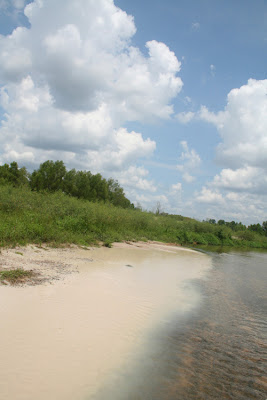

This must be the same one that Dennis saw from the air, because this looks like exactly what he described - cream being poured into a cup of tea. The tan color on the left is where the sediment is pouring into the river and on the right is how the river looked upstream of this - absolutely so clear that you could see the bottom. You could see fish. I wrote about this in my article Many Rivers, One Bayou.

It was my first time flying in a Cessna and it was amazing! But the sand mines were a disgrace. The sad thing is that in Texas there are no laws requiring reclamation for sand mines unlike other types of mines. So after they cut down all the forests and destroy all the wetlands, they leave a gaping sand pit, sometimes hundreds of acres large. Forever. It never regrows with vegetation because all the topsoil is gone. And because the sand is right on the edge of the river, all the sand leaches into the river filing it in which exacerbates flooding and causes water quality problems.

The problem with the dumping of sediment (specifically they dump the fine talc-like waste that they can't use) into the river is that it clogs up fish gills and kills them, and it smothers benthic organisms that live on the river floor such as our already disappearing freshwater mussels, and other aquatic life. It does not have to be this way because in other states, there are some amazing reclamation efforts - not to mention sand mining industries that are regulated in the first place! In other states, old sand mines have been turned into lakes or nature preserves. I wrote an article for CLEANHouston on Sustainable Solutions to the sand mining issue that links to some examples. The first article for CLEANHouston was called Muddy Waters.

The fishing is far worse in Lake Houston than in Lake Conroe as a result – you get different fish species altogether, and a less healthy aquatic ecosystem. I wrote an article on sand mining for Texas Parks & Wildlife magazine, Many Bayous, One River, which is one of the articles I’m most proud of – especially because after that article was written a Texas Senator introduced legislation to help prevent sand mining on the San Jacinto (SB359). It passed the Texas Senate, and made it out of the House Natural Resources Committee but they ended up not voting on it because they ran out of time. I’m hoping they will reintroduce it this upcoming legislative session. Apparently November is the time for Congress-people to put bills in the hopper.

In the Appalachians, mountaintop coal mining has received a ton of attention and media coverage but so far no one but me has written about sand mining!! And I’ve had a hard time getting national media interested in the topic. I may try to do a documentary on sand mining. Texas agencies (not to mention the Galveston District of the Army Corps of Engineers) engage in some questionable practices when it comes to the situation. Sand is big money. Sand and gravel brings in millions annually to Texas, which feeds a $20 billion dollar transportation industry.

The problem is not that we need to put a stop to sand mining altogether, but it needs to happen in a river or stream away from a major metropolitan area, because the illegal dumping – and the devastation of the forests around the river and lake – end up costing taxpayers money. Just like we taxpayers are bailing our greedy companies on Wall Street, taxpayers in Texas pay for the illegal activities – and even the legal ones – of the sand mines along the river. The river gets "filled in" from excess sediment and taxpayers foot the bill for any dredging of the river and lake.

But there's something far more serious. Treating the drinking water from Lake Houston is so costly (3 times that to treat the other water treatment plants-$600/MG vs $200/MG; Region H Water Planning Meeting, Mike Turco) because of the excess sediment that the City of Houston expressed interest in getting that legislation passed. They know the link between sediment and blooms of algae and cyanobacteria – which kill fish and cause odor and taste problems in drinking water. The photo below, which I've titled schmung, is a pea green bloom of yukness that was in the river just downstream of the sediment dumping.

Turns out, those very blooms may be toxic and cause long-term neurological disease. Research by top-notch scientists Paul Cox, Oliver Sacks and Sandra Banack of the Institute for Ethnomedicine has recently linked cyanobacteria and the associated toxin BMAA to neurodegenerative diseases, including Parkinson's, Lou Gherig's (ALS) and Alzheimer's. These studies have been published in journals such as Science, PNAS, and Neurology. See the Honolulu Star Bulletin newspaper article for a general interest piece, Water-scum toxin linked to nerve ailments.


Write to Senator Tommy Williams, District 4, who sponsored the bill last session (tommy.williams@senate.state.tx.us), and represents Harris County and ask him to reintroduce the legislation, and tell of your support for the bill. You can read the full text of the previous version at the link above to SB359. It sets up a "pilot project" on the San Jac that is similar to the one they have on the John Graves Scenic Waterway segment of the Brazos River, where they limited sand mining due to efforts by Walmart heiress Alice Walton.